
Introduction
Universal Studios’ Celestial Park represents one of the most ambitious themed‑environment developments of the decade—a central hub within Universal’s Epic Universe that blends immersive storytelling with expressive architectural forms. At the heart of this environment are its iconic domes, skylights, and transparent envelope systems that create a sense of openness and cosmic wonder. For structural and façade engineers, these elements showcase how modern entertainment architecture increasingly relies on high‑performance building‑envelope systems that merge durability, safety, and visual lightness.
Our Contribution: Structural Design of the Promenade Skylight System
Aquinas Engineering was proud to contribute to this landmark project through the structural design and engineering of the promenade skylight systems. These skylights form a continuous ribbon of natural light above key pedestrian pathways, acting as both wayfinding elements and architectural focal points.
Our team’s role included the structural analysis of the glazing assemblies, support framing, anchorage, and embed alignment within a complex network of surrounding dome structures. The curvature and geometry demanded a careful balance between structural performance and architectural transparency. This required close coordination with fabricators and installers to ensure the skylight assemblies maintained slender sightlines while resisting wind uplift, thermal movement, and long‑term service loads.
We refined support patterns to optimize load paths, reduced system depth where possible, and introduced detailing improvements to better manage thermal stresses across the assemblies. The final system delivers both the desired visual lightness and the performance robustness needed in a high‑traffic themed‑entertainment environment.
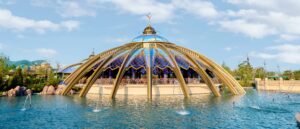
Architectural Vision Behind the Domed Structures
Celestial Park’s domed structures are more than architectural forms—they guide spatial experience and reinforce the park’s celestial theme. The design intent centered on creating spaces filled with diffused daylight and panoramic views of the sky, giving visitors a sense of openness as they move through the park. The domes’ geometry integrates seamlessly with themed elements, show‑set pieces, and surrounding landscaping features, requiring thoughtful coordination across architectural, structural, and building‑envelope engineering disciplines.
Structural Challenges of Large‑Scale Dome and Skylight Systems
Engineering domed and skylit structures of this scale involves several complexities. Irregular geometric grids, variable support conditions, and long-span curved assemblies demand advanced analysis and precise tolerance control. Wind uplift and thermal expansion become particularly critical in Central Florida’s climate, where temperature swings and humid conditions place significant strain on glass and aluminum systems.
Integrating these domes and skylights into a mixed‑use program—housing retail, entertainment, and circulation spaces—also required careful attention to deflection compatibility and load transfer. Coordination between primary structure and façade systems was essential to ensure that the envelope could accommodate movements without compromising waterproofing or structural integrity.
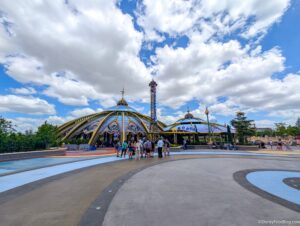
Materials and System Engineering for the Domed Assemblies
The domes and skylights at Celestial Park utilize a combination of steel, aluminum, and hybrid framing systems engineered to deliver both strength and slenderness. Glass selection played a significant role in meeting performance goals: laminated and insulated makeups were optimized to balance impact resistance, solar control, optical clarity, and acoustic needs.
Anchorage detailing ranged from custom extrusions to point-supported connections with concealed reinforcement—each solution tailored to the geometry and support conditions of the corresponding dome segment. Water management and drainage remained a priority, ensuring long‑term performance in Florida’s frequent rainfall while preserving the visual purity of the glass assemblies.
Integration with Adjacent Building Envelope Systems
The domed forms interface with adjacent cladding systems, linear skylights, soffits, and opaque façades. These transitions demanded careful detailing to maintain continuity in air barriers, waterproofing, and thermal layers. The envelope design also had to account for seismic and thermal movement as well as live-load deflections from the supporting primary structure. Successful integration required close collaboration across multiple trades, ensuring lasting performance and visual consistency.
Lessons Learned & Knowledge Contribution to the Industry
Projects of this nature highlight the value of early coordination and fabrication‑driven design. Themed‑entertainment environments present unique constraints—tight geometries, irregular forms, and aggressive performance requirements—that push building-envelope engineers to innovate across materials, tolerances, and structural strategies.
For Aquinas Engineering, the Celestial Park skylight work reinforced the importance of precise anchorage modeling, thermal‑stress analysis, and close collaboration with installers to ensure constructability. These lessons contribute to the industry’s broader understanding of how to engineer complex domed and skylit environments efficiently and reliably.
Conclusion
Universal Studios Celestial Park stands as a testament to the evolving intersection of architecture, engineering, and immersive storytelling. Aquinas Engineering is proud to have contributed to the skylight systems that help define the park’s bright, open promenades. As building‑envelope systems grow in complexity and ambition, we remain committed to advancing the structural engineering knowledge that enables these projects to thrive.
Let’s build something extraordinary together.
📞 Contact us today: 210.237.7854
👉 Visit our website: https://aquinasengr.com/
📧 Email us at info@aquinasengineering.com
Photo Credit:
Let us build a professional relationship. Tell us about your project today.
I really appreciated how quick and efficient the service was. It made our entire process much smoother. I’d just suggest continuing to maintain the quick turnaround, like getting the stamps within a day. It really helps us when we need them urgently, especially in situations where we might have missed the ball with our customers
Working with Aquinas has been nothing short of a pleasure. Not only are the response times great and consistent, Aquinas also provides strong and validating support above and beyond normal measures. I have zero criticisms. Aquinas Engineering has been an excellent asset to my team’s operation.
Quick fast service, great follow up. Aquinas approaches every project small and large with a high level of professionalism.