
As performance requirements for building enclosures continue to expand, the building envelope is increasingly understood as an engineered system rather than a static architectural boundary. Beyond meeting conventional demands for strength, serviceability, and environmental separation, contemporary envelope systems are expected to contribute to energy efficiency, resilience, occupant comfort, and long-term operational insight. These expectations are driving the integration of sensors and responsive materials directly into façade and enclosure assemblies.
This evolution introduces new technical considerations related to load paths, movement accommodation, durability, and performance verification. Smart building envelopes do not replace fundamental structural principles; rather, they extend them by enabling real-time measurement and adaptive behavior under changing environmental conditions.
The Transition from Static Design to Measured Performance
Conventional envelope design relies on code-prescribed load cases, conservative assumptions, and simplified analytical models to address wind, seismic, thermal, and gravity effects. While these methods remain essential, they inherently lack feedback once the building is in service. Smart envelope systems introduce the ability to measure actual performance over time, creating a data-informed approach to enclosure engineering.
By capturing in place behaviors —such as deflection, differential movement, or temperature gradients —engineers can evaluate whether design assumptions align with real conditions. This measured-performance paradigm supports post-occupancy evaluation, refinement of analytical models, and improved confidence in future designs, particularly for complex or non-standard façade geometries.
Sensor Integration in Envelope Assemblies
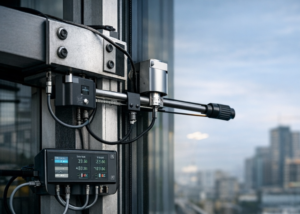
Sensors serve as the primary interface between the physical envelope system and performance data. In façade and enclosure applications, they are typically embedded within framing members, anchors, or interfaces between envelope components and the primary structure. Their placement must be carefully coordinated to avoid compromising structural capacity, waterproofing, or constructability.
Strain gauges and displacement sensors are commonly used to monitor mullion stresses, anchor forces, and inter-story drift compatibility. These measurements are particularly valuable in high-rise construction, where wind-induced movement and cumulative tolerances govern many aspects of façade design. Temperature and humidity sensors are often incorporated to track thermal gradients across assemblies, assess condensation risk, and evaluate the long-term effectiveness of thermal breaks and air/vapor barriers. In some applications, accelerometers and vibration sensors are used to study dynamic façade response under wind loading, informing both serviceability criteria and occupant comfort considerations.
From an engineering perspective, sensor data provides empirical evidence that can validate or challenge design assumptions, offering insight into actual load sharing, boundary conditions, and movement demands.
Responsive Materials and Adaptive Envelope Behavior
In parallel with sensing technologies, responsive materials are being incorporated into envelope systems to actively or passively adjust performance in response to environmental stimuli. These materials introduce time-dependent and non-linear behavior that must be addressed during design.
Electrochromic and thermochromic glazing systems modify solar heat gain and visible light transmittance based on electrical input or temperature changes, directly influencing thermal loads on the enclosure. Phase-change materials integrated into wall or roof assemblies absorb and release latent heat, reducing peak temperature swings and moderating interior conditions. Other emerging applications include shape-memory alloys used in shading devices or connection components that respond predictably to temperature variations, as well as membranes with variable permeability that adjust vapor diffusion characteristics based on ambient humidity.
These systems require careful consideration of changing stiffness, thermal expansion characteristics, and interaction with supporting framing and anchorage, especially for envelope engineers.
Structural Considerations for Smart Envelope Systems
The integration of sensors and responsive components directly affects how envelope systems are analyzed, detailed, and reviewed. Load paths must remain explicit and reliable in all operational states of the system. Adaptive elements cannot obscure or disrupt the transfer of wind, seismic, or gravity loads back to the primary structure, particularly under extreme loading scenarios.
Movement compatibility becomes increasingly critical as responsive systems introduce intentional or amplified displacement. Interstory drift, thermal movement, and component-level deformation must be accommodated without inducing unintended stresses in glazing, anchors, sealants, or finishes. Detailing strategies must anticipate both short-term operational movement and long-term creep, relaxation, or degradation of materials.
Redundancy and fail-safe behavior are essential considerations in systems that rely on active components or controls. Envelope performance under power loss, sensor malfunction, or control system failure must remain within acceptable limits. Engineers must therefore evaluate both active and passive performance modes, ensuring that life-safety and serviceability requirements are satisfied regardless of system state.
Durability also takes on added significance, as sensors and embedded technologies are exposed to the same environmental conditions as the envelope itself. Protection from moisture, thermal cycling, ultraviolet exposure, and corrosion must be addressed through detailing and material selection, along with provisions for inspection, maintenance, and replacement where feasible.
Data-Driven Design and Post-Occupancy Evaluation
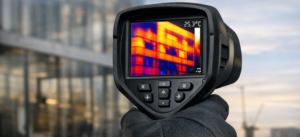
One of the most significant benefits of smart building envelopes is the ability to collect long-term performance data after occupancy. This information can be used to assess actual versus predicted behavior, including façade deflections, anchor loads, thermal performance, and moisture response across different orientations and elevations.
Aggregated post-occupancy data represents a valuable resource. Over time, these datasets can inform improved wind pressure modeling, refined movement criteria, and more efficient material usage. They also support performance-based design approaches, particularly for projects that push beyond prescriptive code limits or involve novel materials and geometries.
The Role of Interdisciplinary Coordination
Smart envelope systems demand a high level of coordination among architects, envelope consultants, structural engineers, manufacturers, and contractors. Sensor placement, wiring, access requirements, and integration with building management systems must be considered early in design to avoid conflicts during fabrication and installation.
Early collaboration allows structural engineers to align adaptive concepts with realistic load paths, tolerances, and constructability constraints. This coordination is especially important when proprietary systems or custom components are involved, as standard assumptions may not apply.
Conclusion
The incorporation of sensors and responsive materials into building envelopes represents a shift toward more measurable, adaptable, and performance-driven enclosure systems. For engineers specializing in façade and envelope design, these technologies expand the scope of traditional structural considerations without diminishing their importance.
As smart envelope systems become more prevalent, the ability to interpret performance data, accommodate adaptive behavior, and design for long-term durability will be increasingly central to effective enclosure engineering. By engaging with these technologies through a rigorous, technically grounded approach, the building envelope community can contribute to safer, more resilient, and better-performing buildings.
Let’s build something extraordinary together.
📞 Contact us today: 210.237.7854
👉 Visit our website: https://aquinasengr.com/
📧 Email us at info@aquinasengineering.com






Let us build a professional relationship. Tell us about your project today.
I really appreciated how quick and efficient the service was. It made our entire process much smoother. I’d just suggest continuing to maintain the quick turnaround, like getting the stamps within a day. It really helps us when we need them urgently, especially in situations where we might have missed the ball with our customers
Working with Aquinas has been nothing short of a pleasure. Not only are the response times great and consistent, Aquinas also provides strong and validating support above and beyond normal measures. I have zero criticisms. Aquinas Engineering has been an excellent asset to my team’s operation.
Quick fast service, great follow up. Aquinas approaches every project small and large with a high level of professionalism.