
Structural engineering is often described as a profession built on experience. Yet some of the industry’s most important lessons were learned not from successful projects, but from failures. Every major collapse becomes a case study that helps engineers better understand structural behavior, refine design methodologies, improve building codes, and develop safer structures.
For those of us who work in the building envelope industry, these lessons are especially valuable. While curtain walls, punched windows, railings, cladding systems, anchors, and embeds are rarely the primary structural system, they are critical components that must safely resist environmental loads and transfer forces to the structure. Many of the same factors that have caused catastrophic structural failures—poor connections, inadequate load paths, overlooked load cases, and durability issues—can affect building envelope systems as well.
The following ten structural failures continue to shape modern engineering practice and offer valuable lessons for today’s building envelope professionals.
1. Tacoma Narrows Bridge (1940)
Few engineering failures are as famous as the collapse of the Tacoma Narrows Bridge in Washington State. Nicknamed “Galloping Gertie” because of its dramatic movement in the wind, the suspension bridge collapsed only four months after opening.
The bridge was not overloaded in the traditional sense. Instead, engineers underestimated the effects of aerodynamic forces and dynamic behavior. Wind-induced oscillations grew uncontrollably until the structure failed.
The collapse fundamentally changed how engineers evaluate wind effects and structural dynamics. Before Tacoma Narrows, wind was commonly treated as a relatively simple static load. Engineers now understand that structures can respond dynamically to environmental forces in ways that create effects far greater than those predicted by static calculations.
For building envelope engineers, this lesson remains highly relevant. Curtain walls, screen walls, canopies, and glass railings are continually exposed to wind loads. On tall buildings, serviceability concerns such as vibration, movement, and occupant comfort can be just as important as strength requirements. A facade system that meets design pressure requirements may still perform poorly if dynamic behavior is not adequately considered.
2. Hyatt Regency Walkway Collapse (1981)
The collapse of the suspended walkways at the Hyatt Regency Hotel in Kansas City remains one of the deadliest structural failures in American history. During a social gathering, two elevated walkways collapsed, resulting in 114 fatalities and more than 200 injuries.
The root cause was a seemingly minor design modification. A change made during fabrication altered the load path within a critical hanger rod connection, effectively doubling the force applied to a connection element that was not designed to resist it. The revised detail was not subjected to a sufficiently rigorous engineering review.
The lesson is simple but profound: connections matter.
Structural engineers often focus on major framing members, but many failures originate at relatively small components where loads are transferred from one element to another. A connection can only be as strong as its weakest component.
Building envelope engineers encounter this challenge on nearly every project. Curtain wall anchors, embed plates, glazing supports, bracket systems, and handrail attachments all serve as critical connections within the overall load path. Minor modifications made during fabrication or installation can have significant consequences. Every design change, regardless of how small it appears, should be evaluated with the same level of engineering rigor as the original design.
3. Ronan Point Apartment Collapse (1968)
In 1968, a gas explosion in a corner apartment of the Ronan Point tower in London triggered a partial collapse of the building. The initial explosion was relatively localized, but the structure lacked sufficient redundancy to prevent the damage from spreading.
As a result, the failure of a single portion of the building caused a progressive collapse that propagated through multiple floors.
The Ronan Point disaster changed how engineers think about structural robustness and disproportionate collapse prevention. Modern codes and design practices increasingly recognize the importance of providing alternate load paths so that localized damage does not lead to catastrophic consequences.
Building envelope systems can benefit from the same philosophy. Facade support structures, window systems, and cladding attachments should be detailed to avoid disproportionate consequences from localized failures. Redundancy may not always be visible in a completed facade, but it often plays an important role in maintaining long-term safety and resilience.
4. Hartford Civic Center Roof Collapse (1978)
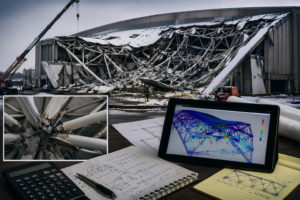
The roof of the Hartford Civic Center in Connecticut collapsed overnight following a snowfall, less than three years after construction was completed. Fortunately, because the building was unoccupied, no lives were lost.
Investigators found that design assumptions and analytical models failed to accurately predict the behavior of the long-span space-frame roof. Small discrepancies between assumed and actual structural behavior accumulated until the system became unstable.
The incident highlighted the limitations of analytical models and reinforced the importance of engineering judgment. Even sophisticated calculations can produce misleading results if critical assumptions are incorrect.
Today’s building envelope systems are increasingly complex. Large-span glazing systems, custom facade geometries, cable-supported structures, and architecturally exposed steel components require advanced analysis techniques. Engineers must understand not only how to build a model, but also how to validate that the model reflects real-world behavior.
5. World Trade Center Building 7 (2001)
The collapse of World Trade Center Building 7 on September 11, 2001, provided engineers with important insights into structural fire behavior and thermal effects.
Unlike many structural failures, the collapse was driven largely by the effects of prolonged fire exposure. Heat-induced expansion created unexpected stresses and displacements within the structure, leading to progressive failure.
One of the most significant lessons was that thermal movement can be just as important as traditional strength considerations.
For building envelope engineers, thermal expansion and contraction are everyday design challenges. Curtain walls, metal panels, glazing systems, and support brackets routinely experience temperature-induced movement. When movement is restrained, substantial forces can develop. Proper detailing of expansion joints, anchors, and movement accommodations is critical to maintaining long-term system performance.
6. Charles de Gaulle Airport Terminal 2E Collapse (2004)
Shortly after opening, a portion of Terminal 2E at Charles de Gaulle Airport in Paris collapsed unexpectedly, resulting in several fatalities.
The investigation identified a combination of factors, including inadequate redundancy, localized stress concentrations, and issues related to the complex geometry of the structure. The project pushed architectural boundaries but exposed vulnerabilities that were not fully recognized during design and construction.
The failure serves as a reminder that innovative architecture requires equally innovative engineering scrutiny.
This lesson applies directly to modern facade design. Curved facades, free-form geometries, oversized glazing systems, and custom support structures often behave differently than conventional systems. Engineers must carefully evaluate load transfer mechanisms, stress concentrations, and constructability considerations to ensure that architectural ambition is supported by sound engineering principles.
7. FIU Pedestrian Bridge Collapse (2018)
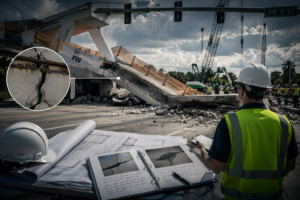
In 2018, a newly constructed pedestrian bridge at Florida International University collapsed while vehicles traveled beneath it.
The most troubling aspect of the failure was that warning signs existed before the collapse. Significant cracking had been observed, discussed, and documented, yet the true severity of the problem was not fully understood.
The bridge collapse underscores the importance of engineering observation and professional judgment. Calculations and models are essential, but they cannot replace what engineers see in the field.
For building envelope projects, field observations are equally important. Cracked welds, distressed anchors, unusual glass movement, excessive deflections, water infiltration, and unexpected installation conditions should never be ignored. Physical evidence often provides the earliest warning that a system may not be performing as intended.
8. Champlain Towers South Collapse (2021)
The collapse of Champlain Towers South in Surfside, Florida, shocked engineers and the public alike. Investigations revealed evidence of significant deterioration, long-term water intrusion, corrosion, and deferred maintenance.
Although the event involved multiple factors, one of the clearest lessons is the importance of durability and lifecycle performance.
Structural safety depends not only on good design, but also on the long-term protection of structural components from environmental exposure.
This lesson resonates strongly within the building envelope industry. The building envelope serves as the first line of defense against water intrusion and environmental degradation. Poor waterproofing, failed sealants, inadequate drainage, and corrosion can gradually reduce structural capacity over time. Designing for durability is every bit as important as designing for strength.
9. Citicorp Center Engineering Crisis (1978)
Unlike the other examples on this list, the Citicorp Center did not collapse. However, it remains one of the most important engineering case studies ever documented.
After construction was substantially complete, engineers discovered that certain wind-loading scenarios had not been adequately considered during design. Under specific quartering wind conditions, the building could have experienced stresses significantly greater than anticipated.
Rather than ignoring the issue, the engineering team initiated corrective measures to strengthen the structure.
The key lesson is that engineers must continually challenge design assumptions. Successful projects often depend on the willingness to revisit previous conclusions when new information becomes available.
For building envelope engineers, wind loading assumptions are among the most important factors affecting system performance. Facades often experience complex pressure distributions, localized effects, and building movements that differ from simplified assumptions used during preliminary design. Verification and peer review can be invaluable tools for identifying hidden vulnerabilities.
10. Morandi Bridge Collapse (2018)
The collapse of the Morandi Bridge in Genoa, Italy, highlighted the challenges associated with aging infrastructure.
Over decades of service, environmental exposure, deterioration, and maintenance challenges gradually reduced the reliability of critical structural components. The tragedy demonstrated that even iconic structures require ongoing evaluation and investment to maintain safety.
One of the most important lessons is that engineering responsibility extends beyond initial design.
The same principle applies to building envelope systems. Anchors, embeds, sealants, glazing gaskets, coatings, and support structures all age over time. Engineers should consider inspection access, maintenance requirements, replaceable components, and long-term durability when developing facade systems intended to serve for decades.
Common Lessons Across All Failures
While the circumstances surrounding each of these failures were different, several recurring themes emerge. In many cases, the root cause was not the failure of a major structural element but an overlooked connection, detail, or load path where forces were transferred from one component to another. These events also demonstrate the importance of challenging engineering assumptions and recognizing that analytical models are only as reliable as the inputs and judgments behind them. Time and again, redundancy has proven to be a critical safeguard, helping structures withstand localized damage without experiencing disproportionate consequences. Effective communication among engineers, architects, contractors, fabricators, and owners is another common factor, as misunderstandings or unreviewed design changes have contributed to several historic failures. Equally important is the recognition that structural performance depends on more than initial design strength. Durability, maintenance, inspection, and long-term exposure to environmental conditions such as wind, water, temperature fluctuations, and corrosion can significantly affect a structure’s reliability throughout its service life. Perhaps most importantly, many failures were preceded by warning signs—cracking, excessive movement, deterioration, or other indications of distress—that highlight the value of engineering observation, professional judgment, and a commitment to investigating problems before they become catastrophes.
Conclusion
Structural failures are among the most powerful educational resources available to engineers. Each event discussed here led to changes in design practices, engineering standards, and professional expectations that continue to influence projects today.
For professionals working within the building envelope industry, these lessons are particularly valuable. Facade systems may not carry the primary gravity loads of a structure, but they are complex engineered systems that rely on sound load paths, robust connections, accurate load assumptions, and long-term durability.
At Aquinas Engineering, we believe that studying the successes and failures of the past helps the industry deliver safer, more resilient projects in the future. Whether designing curtain wall anchors, embeds, railings, punched windows, structural glazing supports, or custom facade systems, the underlying principles remain the same: understand the loads, verify the assumptions, respect the connections, and never stop learning.
The history of structural engineering demonstrates a simple truth: every failure leaves behind a lesson. Our responsibility as engineers is to ensure those lessons are never forgotten.
Let’s build something extraordinary together.
📞 Contact us today: 210.237.7854
👉 Visit our website: https://aquinasengr.com/
📧 Email us at info@aquinasengineering.com






Let us build a professional relationship. Tell us about your project today.
I really appreciated how quick and efficient the service was. It made our entire process much smoother. I’d just suggest continuing to maintain the quick turnaround, like getting the stamps within a day. It really helps us when we need them urgently, especially in situations where we might have missed the ball with our customers
Working with Aquinas has been nothing short of a pleasure. Not only are the response times great and consistent, Aquinas also provides strong and validating support above and beyond normal measures. I have zero criticisms. Aquinas Engineering has been an excellent asset to my team’s operation.
Quick fast service, great follow up. Aquinas approaches every project small and large with a high level of professionalism.