
Aging buildings present a unique opportunity and responsibility for structural engineers and envelope specialists. As cities densify and sustainability targets accelerate, the technical craft of retrofitting building envelopes has become central to extending the useful life of existing structures while elevating performance to contemporary standards. This article explores the challenges inherent in retrofitting older envelopes, outlines proven strategies for success, and examines emerging trends shaping the future of retrofit design.
Why Envelope Retrofits Matter
Retrofitting the building envelope is one of the most effective ways to reduce energy consumption, improve occupant comfort, and mitigate long-term deterioration. Many older structures were designed before today’s energy codes and climate resilience considerations. Their walls, windows, and roofs often lack robust air and vapor control, exhibit significant thermal bridging, and rely on attachment strategies or materials that have degraded over decades of service. Strategic retrofits can correct these shortcomings by modernizing control layers, improving glazing and insulation performance, and upgrading anchorage and connections so the façade can resist current wind and seismic demands. The result is a building that performs better thermally, manages moisture more predictably, and preserves its architectural heritage through engineered compatibility.
Typical Challenges Found in Older Buildings
The starting point for any successful retrofit is a disciplined assessment of existing conditions. Material degradation is common: corrosion in embedded metals, spalling in reinforced concrete, efflorescence and mortar loss in masonry, and embrittled or failed sealants around fenestration and joints. Thermal inefficiency often arises from continuous conductive paths through steel or concrete framing and poorly insulated wall cavities or spandrels, which amplify condensation risk and energy waste. Moisture intrusion can be masked by finishes, but the root causes—discontinuous air barriers, mislocated vapor retarders, and insufficient drainage or ventilation—are frequently systemic. Structural limitations may appear when new façade systems or heavier glazing units exceed original design loads or impose different load paths that the existing frame was never intended to carry. Code compliance gaps further complicate the picture, especially when fire-resistance requirements, seismic bracing, and guardrail or impact safety standards have evolved since the building’s original construction.
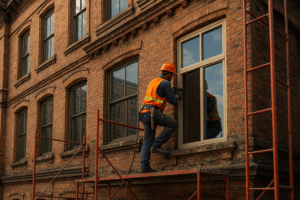
Strategies to Elevate Performance
Effective envelope retrofits address thermal, moisture, air, and structural considerations in an integrated manner. Improvements to thermal performance begin with continuous insulation strategies and the deliberate interruption of thermal bridges using thermal breaks at slab edges, shelf angles, and window perimeter details. High-performance glazing and framing systems can dramatically reduce U-values while controlling solar gain; success depends on careful coordination of sightline constraints, deflection limits, and attachment details so performance gains do not come at the cost of serviceability.
Moisture and air control demand a continuous, durable, and testable assembly. Upgrading or reestablishing air and vapor control layers is essential, and their placement must be informed by climate zone and hygrothermal modeling to avoid interstitial condensation. Rainscreen principles—pressure moderation, drainage, and ventilation—provide robust defense against bulk water while allowing assemblies to dry. Where existing walls are retained, correctly detailed drainage planes, flashings, and weeps become critical, and field verification through water testing and infrared surveys can help validate continuity.
Structural reinforcement and connection design underpin all façade changes. New cladding, curtain walls, or punched windows must be anchored to load-bearing elements that provide adequate resistance to wind pressures, seismic inertial forces, and serviceability demands such as story drift and thermal movement. That often entails designing new embeds, reinforcement, or transfer brackets and verifying that load paths align with the existing frame’s capacity. Connection stiffness, slip, and tolerances should be explicitly addressed to prevent force concentrations, and differential movement between new and old materials should be accommodated through joints and flexible interfaces.
Energy efficiency upgrades can be amplified through passive design refinements, such as improved shading, surface reflectance strategies, and airtightness, which complement mechanical system retrofits. Commissioning and performance testing—blower door testing for airtightness, mock-ups for façade details, and in-situ structural load testing where appropriate—help ensure the retrofit performs as intended once deployed at scale.
Seismic and wind load compliance is non-negotiable in modern practice. Many older façades were never engineered for today’s wind tunnel insights or for current seismic drift and acceleration demands. This necessitates verifying façade-structure interaction under lateral loads, designing connections that tolerate and transfer story drift without damage, and ensuring that heavy components remain stable under out-of-plane excitations. Where heritage constraints limit invasive work, innovative attachment solutions and localized reinforcement can preserve fabric while achieving reliability.
Engineering Considerations That Drive Success
A rigorous structural analysis is foundational. Engineers must assess existing member capacities, connection details, and the practicality of proposed load paths. This includes documenting the existing materials and their condition through selective probes and nondestructive evaluation, confirming dimensions and tolerances, and reconciling record documents with field reality. Compatibility of materials is equally vital. Galvanic corrosion can accelerate deterioration when dissimilar metals are paired without proper isolation. Differential thermal expansion and moisture-induced movement must be predicted and managed through joint design, slip planes, and compliant sealants to maintain watertightness and avoid cracking.
Hygrothermal modeling provides insight into how the retrofitted assembly will behave across seasons and occupancy conditions, helping locate control layers, predict condensation planes, and evaluate drying potential. Engineers should collaborate closely with envelope consultants to select assemblies that perform robustly across climate zones and use testable details. Anchoring and embed design for curtain wall, window wall, and cladding retrofits demands attention to the interaction between the new system and the existing substrate. Edge distances, concrete quality, masonry capacity, and steel thickness determine feasible anchor types and required reinforcement. Construction sequencing and tolerances must be planned to avoid misalignment and to ensure safe installation.
Case Study: Flatiron Building Punched Window Retrofit
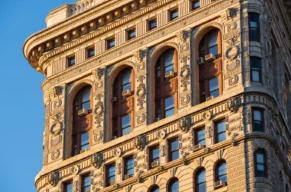
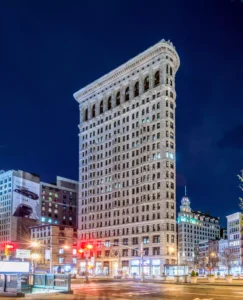
Aquinas Engineering contributed to the retrofit of the Flatiron Building in New York City by performing structural analysis for the punched window system. The challenge was to integrate modern fenestration performance into a historically significant envelope composed of masonry and steel framing, while respecting architectural sightlines and façade rhythm. Our work focused on verifying the capacity of existing substrates to accept new window anchors, designing embed and anchor configurations that provided reliable resistance to wind and service loads, and engineering details that accommodated thermal movement without transferring damaging forces to the historic fabric.
We examined load paths for each window unit, considering local out-of-plane pressures, perimeter frame stiffness, and cumulative effects across elevations. Where existing conditions varied—common in century-old structures—we developed adaptable anchorage details that maintained performance and constructability. Attention to tolerances and joint configuration ensured that sealants and thermal breaks performed as intended, mitigating condensation risk and air leakage. The project demonstrated how thoughtful structural design and envelope coordination can enhance energy efficiency and durability while preserving the iconic character of a landmark building.
Sustainability and Regulatory Drivers
Modern energy codes and sustainability frameworks have reshaped retrofit priorities, emphasizing airtightness, thermal continuity, and moisture control to reduce operational energy and greenhouse gas emissions. Structural engineers working on envelopes increasingly collaborate on lifecycle assessments, selecting assemblies and attachment strategies that minimize embodied carbon while meeting durability targets. Compliance with contemporary fire and life safety provisions, impact safety for glazing, and accessibility requirements must be integrated into retrofit design, often within tight heritage constraints. Early engagement with code officials and preservation authorities can streamline approvals and support solutions that balance performance, safety, and conservation.
Emerging Directions in Envelope Retrofits
The future of envelope retrofits is trending toward prefabrication, smart façades, and integrated energy generation. Prefabricated over-cladding and retrofit panel systems can compress schedules, improve quality control, and reduce occupant disruption. Dynamic glazing and responsive shading offer better thermal and visual comfort with reduced energy use. Building-integrated photovoltaics enable façades to generate onsite renewable power while contributing to aesthetic goals. As these technologies mature, structural engineers will play a central role in ensuring that new systems are safely and efficiently anchored, compatible with existing frames, and resilient under lateral and thermal actions.
Conclusion
Retrofitting the building envelope is both a technical challenge and an opportunity to steward building heritage into a high-performance future. Success hinges on disciplined assessment, integrated thermal and moisture strategies, and robust structural design of anchors and connections. The Flatiron Building punched window retrofit illustrates how Aquinas Engineering approaches these projects: by aligning modern performance requirements with the realities of existing structures and the aspirations of architectural preservation. As the industry advances, collaborative, model-informed design and careful execution will continue to elevate older buildings, delivering comfort, efficiency, and durability for decades to come.
Let’s build something extraordinary together.
📞 Contact us today: 210.237.7854
👉 Visit our website: https://aquinasengr.com/
📧 Email us at info@aquinasengineering.com
Photo Credit:
- Microsoft Copilot
- https://www.smithsonianmag.com/smart-news/new-york-citys-iconic-flatiron-building-went-up-for-auctionand-sold-to-the-tune-of-190m-180981875/
- Microsoft Copilot

Let us build a professional relationship. Tell us about your project today.
I really appreciated how quick and efficient the service was. It made our entire process much smoother. I’d just suggest continuing to maintain the quick turnaround, like getting the stamps within a day. It really helps us when we need them urgently, especially in situations where we might have missed the ball with our customers
Working with Aquinas has been nothing short of a pleasure. Not only are the response times great and consistent, Aquinas also provides strong and validating support above and beyond normal measures. I have zero criticisms. Aquinas Engineering has been an excellent asset to my team’s operation.
Quick fast service, great follow up. Aquinas approaches every project small and large with a high level of professionalism.