
Introduction
The structural design of building envelopes – especially curtainwall and glazing systems – is entering a new era with the publication of the 2024 International Building Code (IBC 2024) and ASCE 7-22 standards. These updated codes bring significant changes that seasoned structural engineers must grasp to ensure curtainwalls meet the latest safety and performance criteria. The IBC 2024 adopts ASCE 7-22 as its primary reference for loads, meaning wind pressures, deflection limits, anchorage forces, and serviceability considerations for façades are all affected by the new provisions. This article highlights the most impactful updates in IBC 2024 and ASCE 7-22 related to building envelopes, with a focus on curtainwall and glazed façade systems. We’ll delve into revised wind load requirements, stricter deflection and drift criteria, improved anchorage provisions, and practical tips for compliance – all in the context of U.S. design practice and code adoption trends.
Updated Wind Load Requirements for Envelopes
Perhaps the biggest change for envelope design is the update to design wind pressures via ASCE 7-22. IBC 2024’s Chapter 16 now references the new ASCE 7-22 wind maps and methods. What does this mean for curtainwalls? In short: the design wind pressures on cladding may increase or decrease depending on location, due to refined wind speed data. ASCE 7-22 provides updated basic wind speed maps for the U.S., with notable adjustments in hurricane-prone regions. For example, along the Florida Panhandle and parts of coastal Texas, basic wind speeds have increased (in some areas by ~5–10 mph) to reflect recent hurricane modeling. Conversely, along the North-Atlantic coast, wind speeds have been slightly reduced – the 130 mph contour moved offshore, effectively removing the North-Atlantic from the highest wind design zone. These map changes directly translate to different wind pressure demands on façades. A curtainwall in Houston or the Florida Big Bend designed to ASCE 7-22 will likely see higher wind pressures than under the old maps, whereas a similar façade in Boston or New York may see a small reduction in design wind pressure due to the lowered regional wind speeds.
In practical terms, engineers should obtain the latest wind design data for the project’s location – ASCE 7-22’s digital hazard tool is a useful resource. Updated wind pressures can affect glass thickness, mullion sizing, and anchor forces. Importantly, the definition of the Wind-Borne Debris Region (WBDR) – which mandates impact-resistant glazing in hurricane zones – has shifted. Because the 130 mph wind line is now further offshore in the Northeast, portions of the Mid-Atlantic and New England coastline are no longer considered within the WBDR under ASCE 7-22. Meanwhile, the WBDR in the Southeast remains largely the same, since basic speeds there still exceed 140 mph. Engineers should verify if their project’s location triggers impact glazing requirements under the new maps. In many areas of the North Atlantic, conventional non-hurricane glazing is now permitted due to the map changes.
Beyond the maps, ASCE 7-22 introduces new wind design provisions that envelope designers should note. One significant addition is an altitude (air density) adjustment factor in the wind pressure equation. The velocity pressure formula now includes a factor KeKe for air density, acknowledging that at high elevations wind pressures are lower for the same wind speed. For a curtainwall project in Denver (roughly 1,600 m above sea level), this could reduce design wind pressures by roughly 10–15% compared to sea-level assumptions – a non-negligible relief for cladding connections and glass stress. On the cutting edge, ASCE 7-22 also formally recognizes performance-based wind design for the first time, allowing alternative wind analysis (such as rigorous wind tunnel studies or CFD simulations) subject to authority approval. In practice, most high-rise projects already use wind tunnel testing for façade pressure mapping, but the code’s blessing of performance-based methods may encourage engineers to propose tailored wind criteria for unusual structures. Still, the prescriptive Components & Cladding wind loads in ASCE 7 remain the baseline for most designs. Engineers must design curtainwall panels, mullions, and fasteners for these localized peak pressures, which are typically highest at building corners and edges per ASCE 7’s cladding zone definitions.
Tornado Wind Provisions: A noteworthy update, though affecting a narrower range of projects, is the introduction of tornado load requirements in ASCE 7-22 (new Chapter 32). The IBC 2024 now requires Risk Category III and IV buildings in certain high-tornado-risk regions to check tornado wind loads in addition to normal wind. For a hospital or emergency center in the Midwest, this means designing the envelope for extreme tornado wind pressures (e.g. 250+ mph in some regions) if the site falls under the mapped design tornado speed zones. However, tornado design is not mandated for most buildings (Risk Category I & II), and even for critical facilities it often won’t govern if the tornado wind speed is below about EF1 levels. The key takeaway is that code officials are acknowledging tornado risk for essential structures – so in states like Oklahoma or Alabama, a new government building might need impact-resistant glazing or enhanced anchorage to withstand a design tornado. For everyday commercial curtainwalls, wind design still centers on the straight-line wind speeds from ASCE 7’s Chapter 26.
Deflection Limits and Serviceability Considerations
Structural engineers have long grappled with deflection criteria for curtainwalls – too much deflection can crack glass or pop seals, while overly conservative limits can drive up costs. The new codes maintain the traditional deflection limits for framing supporting glass, but also bring serviceability into sharper focus. IBC 2024 carries forward the deflection limits from prior editions: generally, curtainwall framing members supporting glass must not deflect more than L/175 of their span under wind load (with a 0.6 load factor applied) or 3/4″, whichever is less. For longer spans over 13.5 feet, a slightly stricter L/240 plus 1/4″ limit applies. These criteria – essentially unchanged from IBC 2018 and 2021 – aim to protect brittle glass from flexural distortion of its supports. It’s worth noting that historically some building officials enforced L/240 for all glass supports as a rule of thumb, treating glass as a brittle finish. Under IBC 2024, the explicit code minimum is L/175, but the best practice is to check both and use the more stringent requirement if the facade system or glass type demands it. For instance, laminated or heat-strengthened glass can tolerate a bit more flex than plain annealed glass; project specifications sometimes call for tighter deflection criteria to ensure long-term performance (e.g. limiting edge seal movement in insulating glass units). Seasoned engineers will continue to use judgment here – the code provides the floor, not the ceiling, of serviceability standards.
ASCE 7-22, for the first time, puts a stronger spotlight on serviceability in a non-mandatory appendix. Appendix C of ASCE 7-22 provides guidance on deflection, drift, and building movements – highlighting that deflections on the order of 1/300 of the span are often visible and can cause architectural damage or even curtainwall leakage. While these are not enforceable criteria, they serve as reminders: controlling deflection is not just about preventing glass breakage, but also about cladding integrity (think of waterproofing joints that could fail if distorted). Practical tip: On tall curtainwalls or large-span lobby glazing, consider specifying more conservative deflection limits than the bare code minimum. For example, an L/240 limit on mullions under 0.6W (60% wind load) is commonly used to ensure curtainwall glass and seals perform well, especially for multi-story spans or high-end facades where visual distortions of glass are undesirable. Engaging the curtainwall manufacturer early to confirm allowable deflections for their system is wise – many proprietary systems have been tested for specific deflection limits.
Another serviceability aspect is inter-story drift under wind. Tall buildings can sway perceptibly in wind storms, and curtainwalls need to accommodate that movement without damage. The drift due to wind is usually a fraction of the seismic drift, but for very slender towers, wind-induced story drift can be significant for façade design (potentially on the order of H/500 to H/300 per floor). IBC 2024 doesn’t stipulate a specific numeric limit for wind drift on cladding – it implicitly expects the deflection limits (L/175, etc.) and glass stress limits to ensure performance. However, performance-based serviceability criteria (like limiting horizontal floor accelerations or ensuring occupant comfort) may govern in supertall buildings. In those cases, engineers sometimes stiffen the lateral system beyond code-minimum to reduce drift, easing the demands on the curtainwall. The bottom line is that controlling building and component deflections is essential to avoid problems like glass edge pressure, sealant failure, and perceptible “rattling” or distortion of façades during wind events.
Seismic Drift and Anchorage of Curtainwalls
Structural envelopes must also survive building movements during earthquakes. The new codes reinforce the need for robust curtainwall anchorage and drift accommodation. ASCE 7-22 contains refined seismic requirements for nonstructural components, and IBC 2024 mirrors these updates. One key change: anchors in concrete or masonry for nonstructural components (like curtainwall connections to slabs) now must be designed with an explicit overstrength factor Ω<sub>0p</sub>. In practical terms, this means the seismic force used for anchor design is amplified (often by a factor of 2.5) to ensure a ductile failure mode. In previous code editions, it was sometimes ambiguous whether the general building Ω<sub>0</sub> (overstrength) factor applied to nonstructural anchors; ASCE 7-22 clarifies that a dedicated component overstrength factor must be used for anchorsnibs.org. For a curtainwall engineer, this translates to higher design loads for the bolts and inserts that attach mullions to the structure. For example, if a curtainwall seismic force FpFp is 0.5 kips at a given anchor, the design load for a post-installed concrete anchor might be 1.25 kips (using Ω<sub>0p</sub> ≈ 2.5) to prevent brittle failure of the concrete. The takeaway: check the latest component anchorage provisions and coordinate with the structural engineer of record – anchors often require ductile steel elements or additional safety factors to meet these criteria.
Another critical seismic update is how the code addresses inter-story drift and glass breakage. Curtainwall systems must accommodate the lateral story drifts of the building frame during design-level earthquakes. ASCE 7-22 Section 13.5.9 specifically deals with Glazed curtain walls and storefronts, and it now requires determining the drift at which glass will fallout (i.e. be dislodged from its frame) via physical testing or analysis. In essence, the code is saying: prove that your curtainwall can tolerate at least the design drift (∆<sub>design</sub>) without hazardous glass fallout. The typical approach is to use the AAMA 501.6 mock-up test: a full-size mock-up of the curtainwall is racked back-and-forth to simulate seismic story drift until glass cracks or falls out. The drift at failure must exceed the code-prescribed drift (often 2% story height for Risk Category II buildings) to be compliant. This requirement is aimed at life safety – making sure glazing doesn’t pop out and shower occupants or bystanders with glass during a quake. IBC 2024 explicitly mandates that cladding and glazing be designed to accommodate seismic relative displacements. Practically, this involves detailing sliding connections (e.g. slip clips, slot holes in anchors) that allow the curtainwall to drift with the structure, and using glazing systems (gaskets, setting blocks, etc.) that can deform without losing the glass. For example, a unitized curtainwall on a Los Angeles high-rise might use two-stage anchors: under normal conditions the facade is snug, but during a quake the anchors permit several inches of relative movement between floor slabs and the wall. Similarly, larger glazing pocket clearances and corner clearances are provided so the glass doesn’t bind and break when the frame racks.
From a serviceability perspective, beyond just preventing collapse or fallout, many owners want the building envelope to remain weather-tight after a design earthquake. The code’s life-safety drift check (no fallout) is a minimum; it doesn’t guarantee the curtainwall will be leak-free or undamaged. However, forward-thinking engineers and façade consultants often set more stringent drift criteria to protect the envelope’s function. For instance, for a hospital (Risk IV), one might limit seismic drift to ensure glass cracks are avoided entirely, not merely that glass stays in the frame. Mock-up testing can be extended to check not only that glass remains in place, but also that curtainwall seals and gaskets aren’t torn at drift. These performance-based measures go beyond IBC/ASCE requirements but are increasingly considered in resilient design. The main point for practitioners is to coordinate the structural and envelope design early regarding drift. If a moment frame structure is very flexible, it might be cheaper to stiffen the structure than to design a highly articulated curtainwall with oversized movement joints. Early-stage studies of building drift vs. facade capacity can inform whether the solution lies in structural upgrades or in special façade detailing.
Lastly, envelope anchorage must resist not only seismic forces but also heavy wind uplift and suction forces. IBC 2024 continues to require that exterior walls and roof connections have adequate anchorage to resist uplift and sliding from wind (and other loads) – this includes ensuring curtainwall anchors to slabs or spandrels can take the outward pull from wind suction. Typically, curtainwall connections are engineered for the worst-case of wind outward pressure or seismic tension load. Anchor design tip: Don’t overlook the combination of loads: if wind and seismic can reasonably occur sequentially, the anchor and its fasteners should be resilient to both. For example, design the anchor for wind suction pressure (say 60 psf on a large panel) and separately for seismic FpFp; also consider a strength reduction if the structure might displace while wind acts (though code wind loads and seismic loads need not be combined simultaneously by law). Using ductile steel attachment brackets, avoiding brittle welds or concrete breakout as the governing failure, and providing some slop for movement all help create a robust anchorage.
Case Study: High-Wind Curtainwall Design on the Gulf Coast
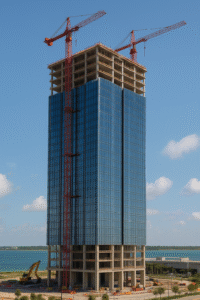
50-story glass curtainwall tower under construction on the Gulf Coast, designed to meet ASCE 7-22 wind load updates. Higher design pressures led to reinforced mullions, impact glazing, and wind tunnel validation to ensure performance in hurricane-prone regions.
To illustrate the impact of these new wind provisions, consider a 50-story office tower on the Gulf Coast (e.g. in coastal Texas). Under ASCE 7-16, the Risk Category II basic wind speed for the region might have been around 140 mph. ASCE 7-22, however, shows parts of the Texas coast with higher wind speeds (up to ~150 mph) for the same return period. Designing this new tower’s curtainwall to the updated code, the structural engineers found that cladding pressures increased by roughly 10%. This meant recalibrating many aspects of the envelope: the glass supplier was asked to provide thicker laminates for the vision glass to withstand higher positive and negative pressures, and the aluminum mullions were upsized to limit deflection under the stronger gusts. The anchorage of the curtainwall units to the floor slabs also saw an uptick in demand – each anchor had to resist greater pull-out forces due to the higher suction pressures. By running the numbers, the engineers confirmed that the revised wind maps and pressure coefficients in ASCE 7-22 would indeed govern the design. To ensure confidence, a wind tunnel test was commissioned. The wind tunnel results largely corroborated the code’s predictions but also gave nuanced data (like higher corner zone suction than code formulae). Armed with this information, the design team implemented reinforced corner mullions and additional screw fasteners for cladding in critical zones. Notably, the project’s location is in a hurricane-prone region, so it firmly remains in the Wind-Borne Debris Region – impact-resistant glazing was specified for the first 60 feet and all upper levels regardless of the code map tweaks. However, in the North-Atlantic states, by contrast, another ongoing project benefited from the ASCE 7-22 changes: a mid-rise Boston waterfront development discovered that, since the 130 mph wind contour shifted seaward, the site was no longer in a wind-borne debris zone. The engineers were able to omit costly hurricane glass on that project, opting for standard tempered insulated glass with confidence that it met the updated code’s life-safety requirements. This comparison shows how regional code changes can materially affect envelope design choices – from thickness of glass and size of mullions to the need for storm-resistant glazing. Seasoned engineers now routinely check the latest maps early in design, knowing that a few mph change in wind speed can have rippling effects on curtainwall performance and cost.
Case Study: Seismic Drift Performance in a West Coast High-Rise
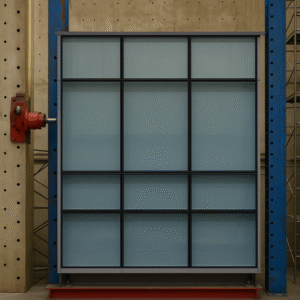
Full-scale curtainwall mock-up undergoing seismic drift testing per AAMA 501.6. This setup simulates lateral story displacement to evaluate glass fallout resistance and gasket performance under ASCE 7-22 requirements.
A new 40-story high-rise in Los Angeles provides a glimpse into applying the seismic envelope provisions of ASCE 7-22. The building’s structural system – a ductile concrete core – was designed for a seismic story drift of approximately 2% of the story height at the Design Earthquake level. The façade is a unitized glass curtainwall. Under prior codes, the engineers would ensure (via previous testing or calculations) that this curtainwall could accommodate the ~2% drift without glass fallout. Under ASCE 7-22 Section 13.5.9.2, it became mandatory to formally determine the drift at which glass fallout occurs for the system. The project team built a full-scale mock-up: two stories of the curtainwall, complete with typical glass units and anchors, were erected in a test facility. Using hydraulic actuators, the mock-up was cyclically pushed to simulate earthquake drifts, per AAMA 501.6. The result? The glass remained safely in the frames up to about 2.5% drift, at which point some edge gaskets started to disengage. This was a pass, as the code-required drift (roughly 2.0%) did not cause any glass to fall out – satisfying the life-safety intent. However, the test revealed a need to improve weatherability: while the glass stayed in place, some silicone seals showed slight tearing at the maximum drift. Learning from this, the design team adjusted the glazing detail – they increased the bite of the structural silicone and specified a more compliant outer gasket. They also enlarged the clearance in the frame’s glass pocket by a few millimeters to allow the glass more free rotation. These tweaks were relatively minor in cost, but they significantly improved the resilience of the façade.
On the anchorage front, the LA high-rise employed custom seismic anchors at each slab: a steel channel was cast into the concrete slab edge, and the curtainwall panels hook into these channels with sliding tabs. The engineers designed these connections to remain intact through the Maximum Considered Earthquake – using the new Ω<sub>0p</sub> factor for anchor design meant the embedded channel and bolt were designed for roughly 2.5 times the force calculated from FpFp. This ensured a ductile failure mode (the steel tabs would yield before the concrete anchor broke out). During peer review (common in high-seismic projects), the reviewers appreciated the rigor of using the updated ASCE 7-22 approach, noting that it increases safety margins for critical connections. The project also highlighted an interesting collaboration: the structural engineer provided predicted floor-by-floor vertical movements (due to seismic settlement and long-term creep), which the curtainwall team used to design slip joints in the mullions. While vertical movements are not a new code issue, it underlines that envelope design in seismic zones must consider 3D movement – up/down and in/out – to prevent damage. In the end, this case study’s curtainwall is expected not only to protect occupants during a design earthquake (no falling glass), but also to be repairable and largely weather-tight afterward. It showcases how applying the new code’s seismic envelope provisions in practice leads to design choices that prioritize both safety and resiliency, from anchor strategy to glazing details.
U.S. Code Adoption Trends
With all these updates, a logical question is: when will my jurisdiction enforce these new rules? Building code adoption in the U.S. is staggered – some states and cities move quickly, others take years or skip editions. As of 2025, the 2024 IBC is just beginning to be reviewed and adopted by jurisdictions. Many states that use the IBC on a 3-year cycle could adopt the 2024 edition in late 2024 or 2025 (for example, jurisdictions that were on IBC 2018 or 2021 will consider jumping to 2024 in the next code update round). Notably, Florida has been proactive: the 8th Edition 2023 Florida Building Code already incorporates ASCE 7-22 for loads, effectively making Florida one of the first regions where designers must use the new wind maps and provisions. Other high-wind states like Texas and Louisiana typically reference the IBC and thus will likely adopt these changes as they update state codes. In California and other high-seismic states, the adoption of the 2024 IBC (and thus ASCE 7-22) might take a bit longer, as state-specific amendments have to be reconciled; however, it is expected by 2026 those states will be enforcing these new seismic drift and anchorage rules. Practically, structural engineers working on projects in different states need to keep track of which code edition is in force. During this transition period, one project might still be under IBC 2018/ASCE 7-16 while another is under IBC 2024/ASCE 7-22. It’s prudent to design for the stricter of the criteria when in doubt, or at least be aware of the differences and communicate with clients about potential impacts (e.g. “if the project permit slips to next year, we may need to revise the curtainwall design for higher wind loads per the new code”). The trend is undeniably toward the new provisions – virtually all U.S. jurisdictions will be on ASCE 7-22 by the latter half of this decade, aligning with the 2024 or 2027 IBC cycles. Early adoption is also seen in some big cities via their amendments; for instance, some cities have already allowed use of ASCE 7-22 on a project-by-project basis to encourage up-to-date resilience. The bottom line is that experienced professionals should start familiarizing themselves with IBC 2024/ASCE 7-22 now, even if their local code hasn’t adopted it yet, to stay ahead of the curve.
Practical Tips for Compliance and Design Excellence
Finally, beyond understanding the letter of the new codes, seasoned engineers will benefit from a few practical strategies when navigating these updates for building envelopes:
- Leverage Updated Tools: Use the ASCE 7 Hazard Tool (online) to quickly get site-specific wind, seismic, and even tornado design parameters per ASCE 7-22. This ensures you start with correct basic loads and don’t miss new factors like altitude KeKe. Early in design, run wind pressure comparisons between ASCE 7-16 and 7-22 for your site – if pressures jumped, alert the project team so budgets can accommodate any necessary upgrades in glazing or framing.
- Coordinate Deflection Criteria Early: Communicate with architects and curtainwall consultants about deflection and drift criteria. While IBC allows L/175, consider specifying stricter deflection limits (L/240 or better) for large glass panes or high-profile façades to minimize visual distortion and ensure waterproofing performance. Make sure the primary structural system will be stiff enough to meet these criteria; if not, discuss options (e.g. adding a mid-span horizontal mullion, or increasing member sizes). It’s easier to adjust structure or mullions in design than to fix building envelope problems later.
- Engage in Performance Mock-ups: With the new emphasis on seismic drift testing (AAMA 501.6) for curtainwalls, allocate time and budget for performance mock-up testing if your project is in a high seismic zone. A full-scale mock-up can reveal issues with both seismic and wind performance (such as curtainwall water penetration under differential movement). Testing provides confidence that code drift requirements are met, and often yields insights that improve the final construction. Use the results to fine-tune glazing details and anchorage – it’s a lot cheaper to adjust the design in the mock-up phase than post-installation.
- Design Anchors Ductile and Strong: Under ASCE 7-22, check anchors with Ω<sub>0p</sub> – ensure there is a clear load path that yields in ductile steel before any concrete or brittle element fails. For curtainwall connections, favor bolted steel plates, threaded rods, and inserts with known ductile capacity. Avoid overly rigid connections; instead, allow a bit of slip or yield to dissipate energy. In wind-prone areas, also verify the anchor’s pull-out capacity for ultimate wind suction – including any increased factors of safety required by local jurisdiction or manufacturer (some facade anchor suppliers specify higher safety factors on tested capacities, for instance).
- Mind the Glass: With higher wind pressures in some regions, check glass design carefully. Use the ASTM E1300 standard to size glass for the new pressures, and consider laminated glass for overhead or high-risk locations even if not explicitly required (laminated glass tends to remain in place if cracked, offering a safety advantage). Where the Wind-Borne Debris Region applies, stay aware of the latest product approvals – some newer glazing products can meet missile impact and cyclic pressure requirements at larger sizes, which can help maintain design intent without adding mullions. Conversely, if your project is in a region that exited the WBDR due to ASCE 7-22 map changes, ensure the building official is on board with the interpretation and document the wind speed and mapping in your calculations to avoid any confusion during plan check.
- Keep an Eye on Code Adoption: As mentioned, confirm which code edition governs your project. If you’re designing ahead (e.g. in 2025 for a project breaking ground in 2026), it might be wise to voluntarily design to the newer code if adoption is imminent. This can prevent redesign headaches if the permit authority updates their code mid-project. At a minimum, be prepared to explain to clients why certain elements (like facade anchors or glass thickness) may need an upgrade – tie it back to the code changes for credibility (“The wind loads in the latest code are ~7% higher here, which is why we recommend a stronger glass spec to maintain safety”).
- Documentation and Collaboration: Document your assumptions for deflection, drift, and testing in the design criteria. On complex envelope jobs, a Basis of Design memo shared between the structural engineer, facade consultant, and architect can outline the agreed-upon criteria (e.g. “Mullions designed for L/200, drift pins allow 3″ seismic movement,” etc.). This avoids misalignment where, say, the structural engineer assumed the curtainwall can tolerate 2.5% drift but the curtainwall supplier was only planning for 1.5%. Early collaboration ensures the structural system and envelope are truly integrated and compliant with the intent of IBC/ASCE provisions.
By following these practices and staying informed on the latest code developments, structural engineers can confidently navigate the path “from code to curtainwall.” The 2024 IBC and ASCE 7-22 updates ultimately push designs toward greater resilience – safer in the face of wind and seismic events – while challenging us to refine our engineering solutions. For the seasoned professional, mastering these changes is an opportunity to deliver building envelopes that not only meet the code, but also stand the test of time in performance and durability.
By Aquinas Engineering
References
-
American Architectural Manufacturers Association. (2015). TIR-A11-15: Maximum allowable deflection of framing systems for building cladding components at design wind loads. American Architectural Manufacturers Association.
-
American Architectural Manufacturers Association. (2017). AAMA 501.1-17: Standard test method for water penetration of windows, curtain walls and doors using dynamic pressure. American Architectural Manufacturers Association.
-
American Society of Civil Engineers. (n.d.). ASCE 7 Hazard Tool [Online tool]. American Society of Civil Engineers. Retrieved May 23, 2025, from https://ascehazardtool.org
-
American Society of Civil Engineers. (2021, December 9). Release of ASCE/SEI 7-22 brings important changes to structural loading standard. ICC Building Safety Journal. https://www.iccsafe.org/building-safety-journal/bsj-technical/release-of-asce-sei-7-22-brings-important-changes-to-structural-loading-standard/
-
American Society of Civil Engineers. (2022). Minimum design loads and associated criteria for buildings and other structures (ASCE/SEI 7-22). Reston, VA: American Society of Civil Engineers.
-
Aquinas Engineering. (2025, May 5). Glass, wind, and code: Navigating curtain wall loads in high-rise structures [LinkedIn article]. LinkedIn. https://www.linkedin.com/pulse/glass-wind-code-navigating-curtain-wall-loads-high-rise-structures-abhsc
-
Federal Emergency Management Agency. (2022). Highlights of significant changes to the wind load provisions of ASCE 7-22 [Fact sheet]. Federal Emergency Management Agency. https://www.fema.gov/sites/default/files/documents/fema_asce-7-22-wind-highlights_fact-sheet_2022.pdf
-
International Code Council. (2023). 2024 International Building Code (IBC). International Code Council.
-
Showalter, J., & Hyde, S. (2024, April 9). 2024 IBC significant structural changes part 6: Loads. Structure Magazine. https://www.structuremag.org/article/2024-ibc-significant-structural-changes-part-6-loads/
-
Structural Engineers Association of Northern California. (2024). Practical guide to seismic bracing and restraint of nonstructural components. Structural Engineers Association of Northern California. https://cdn.ymaws.com/www.seaonc.org/resource/collection/C3170327-620E-4C43-B9B0-ABF7C301D982/SEAONC_Practical_Guide_to_Seismic_Bracing_and_Restraint_of_Nonstructural_Components__2024__resized.pdf



Let us build a professional relationship. Tell us about your project today.
I really appreciated how quick and efficient the service was. It made our entire process much smoother. I’d just suggest continuing to maintain the quick turnaround, like getting the stamps within a day. It really helps us when we need them urgently, especially in situations where we might have missed the ball with our customers
Working with Aquinas has been nothing short of a pleasure. Not only are the response times great and consistent, Aquinas also provides strong and validating support above and beyond normal measures. I have zero criticisms. Aquinas Engineering has been an excellent asset to my team’s operation.
Quick fast service, great follow up. Aquinas approaches every project small and large with a high level of professionalism.