
Museo Soumaya in Mexico City is more than a cultural landmark—it’s a case study in architectural ambition and structural ingenuity. For structural engineers, especially those specializing in curtain wall systems, the museum offers a wealth of insights into non-traditional facade design, parametric modeling, and complex anchoring strategies.
Architectural Vision Meets Engineering Complexity
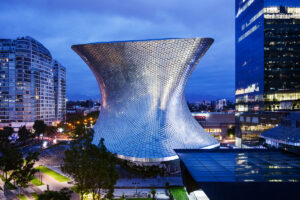
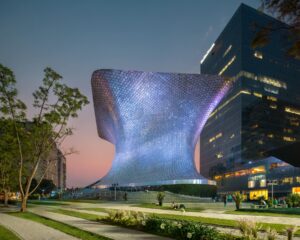
Designed by Fernando Romero and funded by Carlos Slim, Museo Soumaya’s form defies convention. The building’s rotated rhomboid geometry and double-curved surfaces required a departure from traditional curtain wall approaches. Instead of flat glass panels and vertical mullions, the facade features 16,000 hexagonal aluminum tiles mounted on a curved steel diagrid.
Facade System: Curtain Wall Principles in a Sculptural Skin
Although Museo Soumaya’s facade is not a curtain wall in the conventional sense, it shares several fundamental principles that resonate with curtain wall engineering. The aluminum skin acts as a non-load-bearing envelope, supported by a secondary steel structure that operates independently from the building’s primary load-bearing system. This separation of structural roles is a hallmark of curtain wall design. Additionally, the facade serves as an environmental barrier, providing thermal and moisture protection much like high-performance curtain wall systems. One of the most striking aspects of the Soumaya facade is its custom panelization: each of the 16,000 hexagonal tiles was digitally modeled and fabricated to conform precisely to the building’s complex curvature. This level of precision and integration mirrors the demands found in unitized curtain wall systems, where geometry, fabrication, and installation must align seamlessly.
Substructure and Anchoring Challenges
The hexagonal tiles of Museo Soumaya’s facade are supported by a diagrid of curved steel tubes, a structural system that introduced several unique engineering challenges. One of the most critical aspects was connection detailing, as engineers had to design custom anchors capable of accommodating the curvature and variable angles of the steel frame. This required a high level of precision and adaptability in the anchoring system. Additionally, tolerance management became a major concern, since no two tiles were exactly alike. Maintaining consistent alignment and minimizing gaps across the complex surface demanded advanced modeling techniques and strict fabrication controls. Beyond geometry, the facade system also had to address structural performance under environmental forces. Engineers needed to account for wind loads, thermal expansion, and seismic activity, all while preserving the building’s sculptural integrity and ensuring the long-term durability of the facade.
Parametric Design and Digital Fabrication
Museo Soumaya exemplifies the transformative potential of parametric design tools such as Rhino and Grasshopper. Engineers relied on these platforms to simulate the behavior of individual panels, optimize the layout of the hexagonal tiles, and coordinate the complex fabrication process required for the building’s curved surfaces. This approach closely mirrors workflows used in advanced curtain wall projects, where balancing geometry, performance, and constructability is essential. Through parametric modeling, the design team was able to manage thousands of unique components while maintaining architectural intent and structural integrity.
Installation and Sequencing
Installing the facade of Museo Soumaya required a highly specialized approach due to the building’s complex geometry and precision demands. Custom scaffolding and robotic arms were employed to place each hexagonal tile with millimeter-level accuracy, ensuring the sculptural surface maintained its intended form. Engineers developed detailed sequencing strategies to preserve structural stability throughout the installation process and to minimize the need for rework. Additionally, on-site adjustments were necessary to accommodate fabrication tolerances and respond to environmental conditions, further emphasizing the importance of flexibility and coordination in executing such a technically demanding facade system.
Lessons for Curtain Wall Engineers
Museo Soumaya challenges engineers to move beyond the conventions of flat surfaces and modular systems, encouraging a more adaptive and collaborative approach to facade design. One of the key takeaways is the importance of adaptability in design – embracing non-linear geometries and custom components that respond to complex architectural forms. Equally vital is early and ongoing collaboration with architects, which ensures that structural solutions are seamlessly integrated with aesthetic goals from the outset. Finally, the project underscores the growing necessity for digital proficiency; mastery of parametric tools like Rhino and Grasshopper is becoming indispensable in modern facade engineering, where precision, performance, and constructability must be balanced in increasingly sophisticated ways.
Conclusion
At Aquinas Engineering, we believe that projects like Museo Soumaya expand the boundaries of what’s possible in facade design. By studying its structure, curtain wall engineers can gain valuable insights into the future of architectural envelopes—where form, function, and fabrication converge.
Let’s build something extraordinary together.
📞 Contact us today: 210.237.7854
👉 Visit our website: https://aquinasengr.com/
📧 Email us at info@aquinasengineering.com
Photo Credit:
- https://vivepolanco.mx/comprar-con-bitcoins-en-mexico/
- https://cache-graphicslib.viator.com/graphicslib/thumbs210x118/9483/SITours/private-mexico-city-tour-anthropology-museum-and-soumaya-museum-in-mexico-city-464299.jpg
- https://www.carso.com.mx/wp-content/InformesAnuales/GC2023/informacion-para-inversionistas/

Let us build a professional relationship. Tell us about your project today.
I really appreciated how quick and efficient the service was. It made our entire process much smoother. I’d just suggest continuing to maintain the quick turnaround, like getting the stamps within a day. It really helps us when we need them urgently, especially in situations where we might have missed the ball with our customers
Working with Aquinas has been nothing short of a pleasure. Not only are the response times great and consistent, Aquinas also provides strong and validating support above and beyond normal measures. I have zero criticisms. Aquinas Engineering has been an excellent asset to my team’s operation.
Quick fast service, great follow up. Aquinas approaches every project small and large with a high level of professionalism.