
Introduction
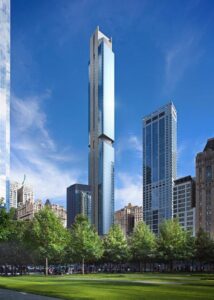
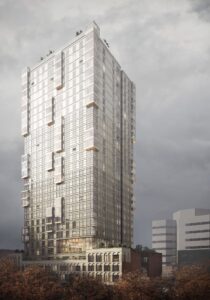
Within the context of New York City’s high-rise residential development, The Greenwich represents a rigorously executed integration of architectural transparency and high-performance building envelope systems. The project exemplifies the increasing reliance on advanced glazing assemblies to achieve both aesthetic and functional objectives, particularly in dense urban environments where views, daylighting, and façade articulation are primary design drivers.
From a structural engineering perspective, the building envelope—specifically the curtain wall and glass railing systems—serves as a critical interface between environmental loading and the primary structural frame. The design and analysis of these systems require a comprehensive understanding of load transfer mechanisms, serviceability constraints, and system interactions.
This article documents key structural engineering considerations associated with these systems and highlights Aquinas Engineering’s contribution in performing detailed structural calculations for the curtain wall and glass handrail assemblies. The intent is to contribute to the broader body of knowledge within the façade engineering and structural engineering community.
Project Overview and Design Challenges
The architectural intent of The Greenwich is characterized by a high degree of façade transparency, achieved through the extensive use of floor-to-ceiling glazing and minimally obstructed railing systems. While architecturally driven, this approach introduces a range of structural engineering challenges directly related to system stiffness, load resistance, and constructability.
The building is subjected to significant lateral wind loads consistent with New York City high-rise exposure conditions. These loads govern the design of façade components, particularly in terms of strength and serviceability criteria. In addition to ultimate limit state (ULS) requirements, serviceability limit state (SLS) considerations—such as deflection limits for mullions and glass panels—are often controlling in glazing system design.
Compliance with the New York City Building Code further necessitates rigorous evaluation of safety factors, redundancy, and load combinations. These requirements extend beyond the primary structure and into the design of non-structural components, including curtain walls and guardrail systems, which must be engineered to resist prescribed loading scenarios while maintaining functional and aesthetic performance.
Curtain Wall System: Structural Engineering Considerations
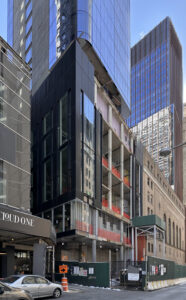
The curtain wall system at The Greenwich functions as a non-load-bearing enclosure system designed to transfer lateral loads, primarily wind pressures, to the primary structural frame. The structural design of the system requires a detailed understanding of load paths from the glazing to the framing members and ultimately to the anchorage interfaces.
Wind loads are imparted on the glass panels and transferred to vertical mullions and horizontal transoms, which act as spanning members between anchorage points. The mullions are typically designed as vertical beams subjected to out-of-plane bending, with boundary conditions defined by anchor stiffness and spacing. Accurate modeling of these boundary conditions is essential to predict realistic deflection and stress responses.
Serviceability criteria are typically more stringent than strength requirements in curtain wall design. Deflection limits, often specified as a function of span (e.g., L/175 or L/240), are imposed to mitigate issues such as visual distortion of glass, sealant degradation, and water infiltration. Additionally, differential movement between floors—manifested as interstory drift—must be accommodated through appropriately detailed connections and joint systems to prevent load transfer into the glazing.
Thermal expansion and contraction further contribute to movement demands, necessitating the incorporation of sliding or flexible connections at anchorage points. These details must balance the need for structural restraint under lateral loading with the need to accommodate multi-directional movements without inducing secondary stresses.
Aquinas Engineering performed structural calculations for the curtain wall system, including analysis of mullion and transom members under governing wind load cases and verification of anchorage systems transferring loads to slab edges or embeds. The scope included evaluation of connection forces, member capacities, and deflection compliance. Coordination with façade consultants and the design team ensured that the structural requirements were aligned with architectural detailing and installation constraints.
Glass Handrail Systems
The glass handrail systems at The Greenwich represent a structurally critical yet visually minimal component of the building envelope. These systems are required to satisfy code-mandated loading criteria while maintaining transparency and minimizing visual obstructions.
Glass railings are designed to resist lateral loads applied at the top rail elevation, including both uniform loads and concentrated point loads as prescribed by applicable codes. These loads induce bending stresses within the glass panels and generate significant reactions at the support conditions.
The structural behavior of laminated glass is central to the analysis. Unlike monolithic glass, laminated glass exhibits composite behavior governed by the stiffness of the interlayer material, which is both temperature- and duration-dependent. Effective thickness methods or more advanced finite element approaches may be required to accurately model the glass response under loading.
Post-breakage performance is a critical design consideration, as laminated systems must maintain residual capacity after fracture of one ply to prevent catastrophic failure. This requirement influences both glass thickness selection and interlayer specification.
The support condition—whether a continuous base shoe, point-supported standoff system, or embedded channel—directly affects load distribution and stress concentrations. Anchorage design must account for combined shear and moment demands, as well as edge distance limitations and substrate capacity.
Aquinas Engineering conducted structural calculations for the glass handrail systems, including determination of required glass build-ups based on load demands, span conditions, and serviceability limits. The analysis also included verification of anchorage systems and connection detailing to ensure adequate load transfer and compliance with code-prescribed safety requirements. Close coordination with fabricators and installers facilitated the refinement of connection details to address fabrication tolerances and field conditions.
Coordination Between Envelope Systems and Primary Structure
The interface between the building envelope systems and the primary structural frame represents a critical coordination point in high-rise construction. Curtain wall anchors must align precisely with structural slab edges or embedded plates, often within tight geometric tolerances.
Interstory drift imposes relative displacements between adjacent floors, which must be accommodated by the façade system without inducing excessive stresses in framing members or glazing. This necessitates the use of drift-compatible anchorage systems and articulation within the curtain wall frame.
Tolerance management is particularly important in ensuring constructability. Variations in slab edge alignment, embed placement, and fabrication tolerances must be anticipated and addressed through adjustable connection details. Failure to account for these factors can result in installation challenges and compromised system performance.
At The Greenwich, proactive coordination between structural engineers, façade consultants, and construction teams enabled the resolution of potential conflicts during the design phase, reducing the likelihood of field modifications and ensuring consistent system performance.
Lessons Learned and Best Practices
One of the primary lessons from The Greenwich is the importance of early-stage integration between structural and façade engineering disciplines. Many governing design criteria, particularly those related to serviceability, must be established early to inform system selection and member sizing.
Constructability considerations should be incorporated into the design process, particularly in urban environments where site constraints and logistical challenges influence installation sequencing. Simplified connection detailing and allowance for adjustment can significantly improve field efficiency.
Additionally, glass systems must be approached with a performance-based design methodology that accounts for both intact and post-breakage conditions. Understanding the time-dependent behavior of interlayer materials and incorporating redundancy into the system are essential for ensuring long-term safety and reliability.
Conclusion
The Greenwich provides a representative case study in the structural engineering of modern building envelope systems, illustrating the complex interactions between architectural intent, structural performance, and constructability constraints.
The curtain wall and glass handrail systems demonstrate the necessity of rigorous analysis, precise detailing, and interdisciplinary coordination to achieve both performance and aesthetic objectives. Through its involvement in the project, Aquinas Engineering contributed structural calculations for these systems, supporting the successful implementation of high-performance glazing assemblies.
As the demand for transparent, high-performance façades continues to grow, projects such as The Greenwich underscore the importance of advancing technical knowledge and fostering collaboration within the structural and façade engineering community.
Let’s build something extraordinary together.
📞 Contact us today: 210.237.7854
👉 Visit our website: https://aquinasengr.com/
📧 Email us at info@aquinasengineering.com
Photo Credit:


Let us build a professional relationship. Tell us about your project today.
I really appreciated how quick and efficient the service was. It made our entire process much smoother. I’d just suggest continuing to maintain the quick turnaround, like getting the stamps within a day. It really helps us when we need them urgently, especially in situations where we might have missed the ball with our customers
Working with Aquinas has been nothing short of a pleasure. Not only are the response times great and consistent, Aquinas also provides strong and validating support above and beyond normal measures. I have zero criticisms. Aquinas Engineering has been an excellent asset to my team’s operation.
Quick fast service, great follow up. Aquinas approaches every project small and large with a high level of professionalism.