
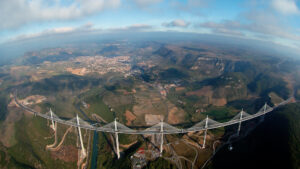
The Millau Viaduct in southern France is widely recognized as one of the most ambitious civil engineering achievements of the 21st century. This iconic cable-stayed bridge spans the Tarn Valley at breathtaking heights, breaking records and redefining the possibilities of modern bridge design.
For structural engineers and construction professionals, the Millau Viaduct is far more than an architectural statement. It is a master class in wind engineering, composite material innovation, and advanced construction management.
A Vision Elevated: Solving a Transportation Challenge
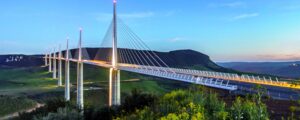
The Millau Viaduct was conceived to address a persistent transportation bottleneck between Paris and the Mediterranean. Traffic congestion in the Tarn Valley had become a serious problem. The straightforward solution—building a traditional road down and back up the gorge—was rejected due to its environmental impact and inefficiency.
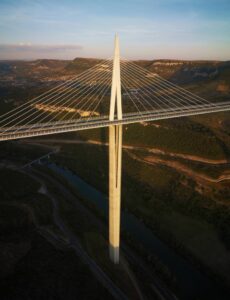
Instead, engineers proposed an elevated viaduct that would soar above the valley with minimal disruption. The design team, led by structural engineer Michel Virlogeux and architect Norman Foster, created a bridge that stretches 2.46 kilometers (1.53 miles) and reaches an astonishing 343 meters (1,125 feet) at its highest pier—making it the tallest bridge in the world.
Extreme Design Challenges at Altitude
Designing a bridge at this scale and elevation presented unprecedented challenges:
Wind forces: The Tarn Valley is notorious for strong, unpredictable winds, making detailed aeroelastic analysis essential to ensure stability and safety.
Long spans: Each main span measures 342 meters. The cable-stayed design had to limit deflection and vibration while maintaining aesthetic simplicity.
Thermal effects: The slender deck needed expansion joints capable of accommodating significant temperature variations without compromising durability or ride quality.
These challenges demanded advanced wind tunnel testing, computational fluid dynamics (CFD) modeling, and physical scale prototypes to validate design choices.
Wind Engineering at the Core of the Millau Viaduct
Aerodynamic stability was a critical priority for the Millau Viaduct. Located high above the valley floor, the bridge is constantly exposed to strong crosswinds. The design team employed extensive wind tunnel studies to develop the deck’s streamlined cross-section, reducing drag and preventing vortex shedding.
Key wind engineering solutions included:
-
Tapered box girder profiles that minimized turbulence and aerodynamic forces.
-
Inclined, multi-strand cable stays engineered to resist and dampen wind-induced vibrations.
-
Tuned mass dampers integrated into the piers and deck to control dynamic responses during high-wind events.
This rigorous wind engineering approach ensured the structure would remain safe and serviceable even in extreme weather.
Composite Materials for Strength and Efficiency
The Millau Viaduct exemplifies innovative use of composite construction to achieve both strength and elegance.
The steel deck was selected for its lighter weight compared to concrete, reducing dead loads on the piers while allowing for slender, graceful profiles. High-performance concrete was used for the piers, capable of supporting enormous vertical loads while resisting creep and shrinkage over time. Hybrid connections using bolted and welded joints were optimized for ease of assembly and long-term durability.
This strategic use of materials not only reduced the environmental footprint of the project but also enabled a design that harmonized engineering performance with aesthetic impact.
Advanced Construction Techniques
Constructing a bridge of this height and scale required pioneering methods:
Incremental launching: The steel deck was assembled in segments and hydraulically pushed across the piers. This minimized work at extreme elevation, enhanced worker safety, and maintained precise tolerances.
Climbing formwork: Custom-designed systems enabled the in-situ casting of piers over 200 meters tall, maintaining vertical alignment and structural integrity throughout construction.
Just-in-time delivery: Prefabricated components were delivered and installed with tight scheduling, reducing the need for large on-site storage and limiting environmental disturbance in the valley.
These advanced techniques are now widely studied and applied in major bridge projects around the world.
Lessons for Modern Structural Engineers
The Millau Viaduct offers valuable lessons for today’s engineering and construction professionals:
-
Integrate design and construction early: Close collaboration between structural engineers, architects, and contractors fosters innovation and practical solutions.
-
Prioritize aerodynamic analysis: For large-scale projects, wind can be a governing load case requiring sophisticated modeling equivalent to seismic design.
-
Use materials strategically: Combining steel and concrete allows for optimized load management, aesthetic freedom, and reduced environmental impact.
-
Adopt innovative construction methods: Techniques like incremental launching and climbing formwork improve safety, quality, and efficiency in challenging environments.
Bridging the Future
Beyond its role as critical transportation infrastructure, the Millau Viaduct stands as a testament to engineering ambition and thoughtful design. It is an enduring landmark on the French landscape—and a milestone in the evolution of structural engineering.
At Aquinas Engineering, we believe projects like the Millau Viaduct remind us to challenge assumptions, embrace complexity, and deliver exceptional results—even when the challenge seems impossible.
Let’s build something extraordinary together.
📞 Contact us today: 210.237.7854
👉 Visit our website: https://aquinasengr.com/
📧 Email us at info@aquinasengineering.com
Photo Credit:
https://www.tourisme-aveyron.com/en/millau-viaduct/discover-millau-viaduct




Let us build a professional relationship. Tell us about your project today.
I really appreciated how quick and efficient the service was. It made our entire process much smoother. I’d just suggest continuing to maintain the quick turnaround, like getting the stamps within a day. It really helps us when we need them urgently, especially in situations where we might have missed the ball with our customers
Working with Aquinas has been nothing short of a pleasure. Not only are the response times great and consistent, Aquinas also provides strong and validating support above and beyond normal measures. I have zero criticisms. Aquinas Engineering has been an excellent asset to my team’s operation.
Quick fast service, great follow up. Aquinas approaches every project small and large with a high level of professionalism.