
The Parthenon in Athens stands as one of the most famous architectural and engineering achievements of the ancient world. Built in the 5th century BCE atop the Acropolis, it remains an enduring symbol of classical design, proportion, and structural ingenuity.
For today’s structural engineers and preservation professionals, the Parthenon offers not only lessons in ancient construction but also a complex case study in modern stabilization and ethical restoration.
Classical Design and Structural Ingenuity
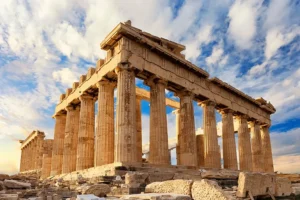
At its core, the Parthenon is a prime example of post-and-lintel construction, perfected through careful design and precision craftsmanship. Its enduring form owes much to classical Greek engineering principles:
Proportion and Harmony
The Parthenon’s layout follows strict ratios, achieving visual balance that has influenced architecture for over two millennia. Subtle refinements, such as column entasis (slight curvature), correct optical illusions and give the structure its graceful appearance.
Post-and-Lintel System
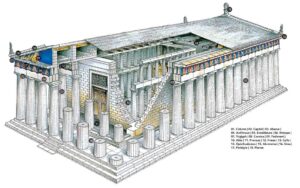
The structural system relies on vertical columns supporting horizontal marble beams. Unlike the later Roman arch, the Greek post-and-lintel required precise load transfer and excellent material performance.
Material Mastery
Engineers selected high-quality Pentelic marble, known for strength and workability. Jointing and dry-fitting of massive stone blocks were so precise that no mortar was needed—an achievement of remarkable craftsmanship.
Seismic Vulnerability in Ancient Structures
Despite its engineering brilliance, the Parthenon’s post-and-lintel design has inherent vulnerabilities, particularly in seismic regions like Greece.
Rigid Connections
The lintel blocks transfer loads directly to columns without flexible connections. This creates high stress concentrations during earthquakes, leading to cracking and collapse of beam sections.
Lack of Ductility
Unlike modern reinforced concrete or steel frames, the marble components have limited capacity to deform without failure.
Foundation Dynamics
The Acropolis rock foundation is generally stable, but differential settlement over centuries can induce additional stress.
Engineers today study these weaknesses to better understand how ancient structures perform under seismic loading—and how to design retrofits that respect their historical integrity.
Centuries of Damage and Degradation
Beyond seismic activity, the Parthenon has endured extensive damage from:
-
Weathering: Acid rain, temperature fluctuations, and freeze-thaw cycles degrade marble surfaces and joints.
-
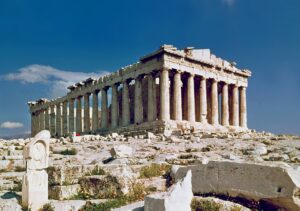
Human conflict: The 1687 Venetian bombardment ignited Ottoman munitions stored inside, causing catastrophic explosion damage.
-
Historical modifications: Over centuries, conversion to a church, mosque, and other uses introduced alterations and weakened the original structure.
-
Pollution: Industrial emissions in modern Athens accelerate chemical weathering, damaging the marble’s crystalline structure.
These cumulative effects leave engineers and conservationists with a complex preservation challenge.
Modern Stabilization and Ethical Restoration
Preserving the Parthenon involves balancing structural stabilization with respect for its historical authenticity. Modern engineers and conservators have undertaken extensive efforts:
Structural Analysis
Advanced finite element modeling helps predict how remaining components respond to seismic forces and weathering, informing safe stabilization strategies.
Reassembly of Fragments
Meticulous documentation and cataloging of fallen stones enable partial anastylosis—reassembling original components in their correct positions.
Seismic Retrofitting
Discrete reinforcement techniques, such as stainless-steel dowels and titanium rods, stabilize cracked or fragmented columns without altering the visual appearance.
Reversible Methods
Best-practice conservation emphasizes reversibility: using techniques that can be undone without damaging original material, in line with international charters like the Venice Charter.
Material Compatibility
Repairs use materials compatible with Pentelic marble to prevent differential weathering or chemical reactions that might damage the structure over time.
Lessons for Structural Engineers
The Parthenon offers timeless lessons that resonate in modern practice:
-
Structural Simplicity with Precision: Even basic systems like post-and-lintel can achieve remarkable durability with careful design and execution.
-
Importance of Materials: Long-lasting construction demands deep understanding of material properties and behavior over time.
-
Vulnerability Analysis: Recognizing inherent weaknesses—especially seismic vulnerability—informs both new designs and retrofit strategies.
-
Preservation Ethics: Modern interventions must balance structural safety with respect for cultural heritage and authenticity.
-
Innovative Retrofitting: Engineers today must develop creative, minimally invasive solutions for stabilizing historic structures.
Bridging Past and Future
The Parthenon is more than an archaeological monument. It is a living laboratory for structural engineers, conservation professionals, and architects. By studying its design, failures, and restorations, we gain insight into the evolution of building technology and the ethics of preserving our shared heritage.
At Aquinas Engineering, we believe that honoring the past through thoughtful engineering strengthens our capacity to build responsibly for the future—even when that means tackling the most complex preservation challenges.
Let’s build something extraordinary together.
📞 Contact us today: 210.237.7854
👉 Visit our website: https://aquinasengr.com/
📧 Email us at info@aquinasengineering.com
Photo Credit:
- https://www.shutterstock.com/image-photo/parthenon-night-on-acropolis-athens-greece-63500788?irclickid=zy212oVG8xycTkxQNMxZ3WzWUkpQ1sQvIzpqUo0&irgwc=1&afsrc=1&pl=77643-108110&utm_medium=Affiliate&utm_campaign=TinEye&utm_source=77643&utm_term=&utm_content=108110
- https://www.shutterstock.com/image-photo/parthenon-temple-on-sinset-acropolis-athens-1614715330?irclickid=zy212oVG8xycTkxQNMxZ3WzWUkpQ1sSuIzpqUo0&irgwc=1&afsrc=1&pl=77643-108110&utm_medium=Affiliate&utm_campaign=TinEye&utm_source=77643&utm_term=&utm_content=108110
- https://www.alamy.com/november-27-2017-ancient-parthenot-model-releasedn-and-ruins-athens-greece-1968-credit-image-jt-vintageglasshouse-via-zuma-wire-image660767338.html?irclickid=T8Y0yFxL-xycRXdzwg3iy28lUkpQ1sSnIzpqUo0&utm_source=77643&utm_campaign=Royalty-free%20stock%20photos%20and%20images%20%E2%80%93%20Alamy%20&utm_medium=impact&irgwc=1&afsrc=1
- https://www.greece-is.com/the-optical-illusions-that-make-the-parthenon-perfect/







Let us build a professional relationship. Tell us about your project today.
I really appreciated how quick and efficient the service was. It made our entire process much smoother. I’d just suggest continuing to maintain the quick turnaround, like getting the stamps within a day. It really helps us when we need them urgently, especially in situations where we might have missed the ball with our customers
Working with Aquinas has been nothing short of a pleasure. Not only are the response times great and consistent, Aquinas also provides strong and validating support above and beyond normal measures. I have zero criticisms. Aquinas Engineering has been an excellent asset to my team’s operation.
Quick fast service, great follow up. Aquinas approaches every project small and large with a high level of professionalism.