
In modern building design, glazing systems have evolved from simple daylight openings into sophisticated, multi-functional components of the building envelope. As performance expectations for structures continue to rise – energy efficiency, resilience, durability, and occupant comfort – glazing systems now play a central role in delivering high-performing facades. For structural engineers working within the building-envelope discipline, understanding the mechanics, demands, and design considerations of these systems is no longer optional; it’s foundational.
Glazing Systems as Structural Components
Glazing systems must do far more than provide transparency. They act as structural elements that transfer loads- wind, seismic, dead, thermal, and occasionally blast loads-through the façade to the primary building structure.
Wind load resistance is a central structural function of glazing systems. Mullions, transoms, and glass lites must be engineered to limit deflection, stress, and vibration while meeting the increasingly rigorous performance criteria dictated by codes and project specifications. Anchorage and embed design also play a vital role; the connections between façade components and the building structure must account for edge distances, concrete breakout, deformation limits, and architectural tolerances to ensure long-term reliability. Additionally, glazing systems must accommodate inter-story drift as a building moves due to lateral demands. This is especially critical in tall or seismically active regions, where improper detailing can lead to glass breakage or premature sealant failure. Together, these factors underscore the need for glazing systems to be treated as true structural systems rather than mere architectural features.
Energy Performance and Thermal Behavior
The building envelope is responsible for a significant portion of a building’s overall thermal performance, and glazing systems are engineered to make meaningful contributions to energy efficiency. Thermal breaks are incorporated into framing members to reduce conductive heat transfer, allowing metal framing to perform well even in challenging climate zones. High-performance insulated glass units (IGUs) combine low-E coatings, gas fills, and selective glazing assemblies to control solar heat gain while improving U-values without compromising daylight or visibility. Many facades also integrate shading elements -such as fins, overhangs, or dynamic glazing- that enhance solar control based on orientation or real-time environmental conditions. These thermal considerations overlap with structural engineering concerns, as thermal expansion, condensation mitigation, and differential material movement must all be addressed during design to ensure both energy and performance and structural reliability.
Air, Water, and Vapor Control
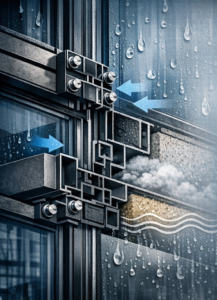
The faced serves as the building’s first line of defense against weather, and glazing systems form a crucial part of this barrier. To maintain airtightness and resistance to water penetration, glazing systems rely on pressure-equalized chambers, properly designed gaskets, and reliable weepage paths that guide moisture away from critical components. Sealants and gaskets must be selected with careful attention to their UV resistance, compatibility with adjacent materials, movement capacity, and long-term durability to prevent premature system degradation. Vapor control is equally important; poor detailing can lead to condensation within the assembly, contributing to corrosion, mold development, or diminished thermal performance. Achieving effective control layering requires careful collaboration between engineers, architects, and manufacturers to ensure the structural detailing supports, rather than undermines, the facades’ environmental performance.
Design Coordination and Integration
High-performance glazing systems sit at the intersection of architecture, engineering, and specialty fabrication, making coordination essential to project success. Tolerance management across trades is often one of the most significant coordination challenges, as façade components must align with primary structure dimensions despite differing fabrication methods and tolerances. Structural support points must also be coordinated with architectural modulation to ensure that anchors, embeds, and connection hardware fit seamlessly within the intended design. Movement joints must be compatible with both structural requirements and façade geometry, preventing unintended stress concentrations as the building undergoes daily and long-term movement. Additionally, the integration of operable elements, shading devices, ventilation strategies, or other building-envelope technologies must be addressed early to maintain performance while preserving constructability. This level of coordination demands a holistic approach that engages all stakeholders from concept through installation.
The Structural Engineer’s Role in Advancing the Envelope
At Aquinas Engineering, we believe structural engineers are uniquely positioned to elevate the performance of building facades. Our work with curtain wall, window wall, and specialty glazing systems has demonstrated how precise engineering can directly enhance architectural expression, sustainability goals, and occupant comfort. As glazing systems continue to evolve- embracing new materials, intelligent technologies, and increasingly complex geometries- the role of structural engineering becomes even more influential in ensuring safe, durable, and high-performing building envelopes.
High-performance buildings start with high-performance envelopes. And high-performance envelopes depend on engineering that is deeply informed, detail-oriented, and collaborative.
A Call to Collaboration
Aquinas Engineering is committed to partnering with glaziers who share our dedication to excellence in building-envelope design. Whether you are navigating a complex façade geometry, optimizing anchorage strategies, or seeking engineering support for system performance, we welcome the opportunity to collaborate. Together, we can advance the craft, ensuring that each project achieves its full structural and architectural potential.
Let’s build something extraordinary together.
📞 Contact us today: 210.237.7854
👉 Visit our website: https://aquinasengr.com/
📧 Email us at info@aquinasengineering.com




Let us build a professional relationship. Tell us about your project today.
I really appreciated how quick and efficient the service was. It made our entire process much smoother. I’d just suggest continuing to maintain the quick turnaround, like getting the stamps within a day. It really helps us when we need them urgently, especially in situations where we might have missed the ball with our customers
Working with Aquinas has been nothing short of a pleasure. Not only are the response times great and consistent, Aquinas also provides strong and validating support above and beyond normal measures. I have zero criticisms. Aquinas Engineering has been an excellent asset to my team’s operation.
Quick fast service, great follow up. Aquinas approaches every project small and large with a high level of professionalism.